
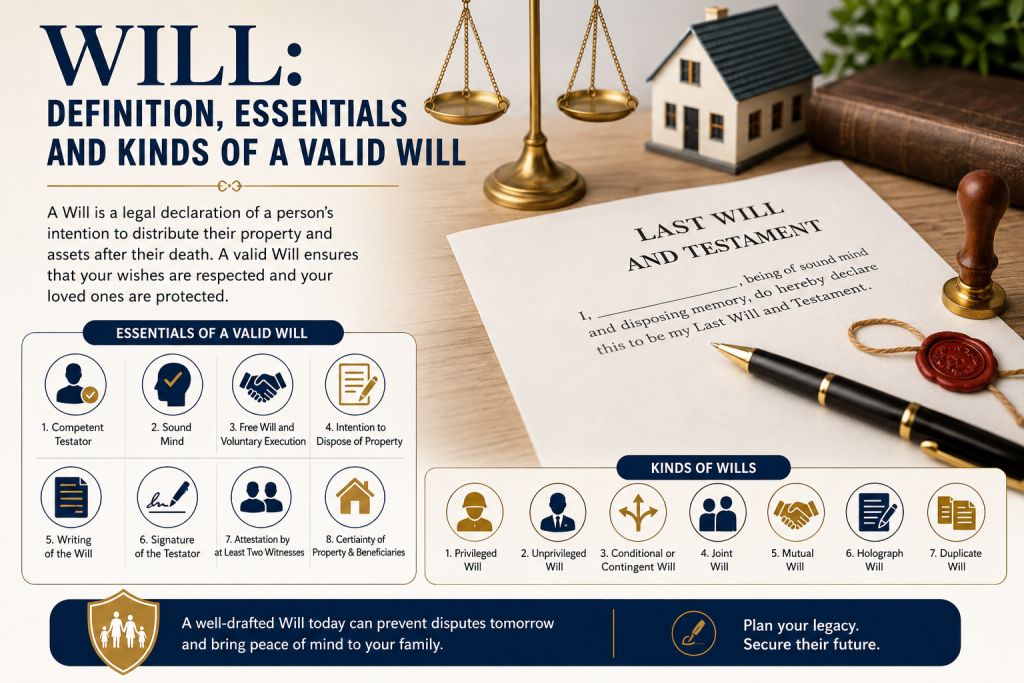
Will Deed: Definition, Essentials and Kinds of a Valid Will
Legal EducationTable of Contents
ToggleIntroduction
A Will is one of the most important legal documents a person can create during their lifetime. Will Deed allows an individual to decide how their property and assets will be distributed after their death. A properly drafted Will deed helps avoid disputes among family members, ensures that the wishes of the deceased are respected, and provides clarity regarding the succession of property.
In India, the law relating to Wills is primarily governed by the Indian Succession Act, 1925. Understanding the meaning, essential requirements, and different kinds of Wills is important for anyone who wishes to plan the future distribution of their estate.
Definition of a Will
A Will is a legal declaration made by a person regarding the distribution of his or her property after death. The person making the Will is known as the testator (or testatrix in the case of a woman), and the person who receives property under the Will is called a beneficiary.
Section 2(h) of the Indian Succession Act, 1925 defines a Will as:
“The legal declaration of the intention of a testator with respect to his property which he desires to be carried into effect after his death.”
A Will becomes effective only upon the death of the testator. Until then, it can be modified, replaced, or revoked at any time.
Essentials of a Valid Will Deed
For a Will to be legally valid and enforceable, certain essential requirements must be fulfilled.
1. Competent Testator
The person making the Will must be legally competent. Generally, any person who has attained the age of majority and is of sound mind can make a Will.
A person suffering from temporary illness, old age, or physical disability can still make a valid Will if they understand the nature and consequences of their actions at the time of execution.
2. Sound Mind
The testator must possess a sound and disposing mind. They should understand:
- The nature of the document being executed.
- The extent of their property.
- The persons who are likely to inherit their estate.
A Will made under mental incapacity may be challenged and declared invalid.
3. Free Will and Voluntary Execution
A valid Will must be executed voluntarily. It should not be the result of:
- Fraud
- Coercion
- Undue influence
- Misrepresentation
If it is proved that the testator was forced or manipulated into making the Will, the document may be set aside by a court.
4. Intention to Dispose of Property
The document must clearly express the intention of the testator to distribute property after death. Any ambiguity regarding such intention may lead to disputes regarding interpretation.
5. Writing of the Will Deed
Although certain oral Wills may be recognized in limited circumstances, a written Will is strongly preferred. A written document provides certainty and serves as reliable evidence of the testator’s wishes.
6. Signature of the Testator
The Will must be signed by the testator or by another person acting under the testator’s direction and in their presence.
The signature should indicate approval of the contents of the document.
7. Attestation by Witnesses
Under Section 63 of the Indian Succession Act, a Will must generally be attested by at least two witnesses.
Each witness should:
- See the testator sign the Will; or
- Receive acknowledgment from the testator regarding the signature.
The witnesses should sign the document in the presence of the testator.
8. Certainty of Property and Beneficiaries
The Will should clearly identify:
- The property being distributed.
- The beneficiaries receiving such property.
Clear drafting minimizes future disputes among legal heirs.
Kinds of Wills
The law recognizes different types of Wills depending upon the circumstances in which they are made.
1. Privileged Will
A Privileged Will can be made by soldiers, airmen, or mariners engaged in actual warfare or expedition.
Such persons are given special privileges due to the nature of their duties. In certain situations, even an oral declaration may constitute a valid Privileged Will.
2. Unprivileged Will
An Unprivileged Will is the ordinary Will made by a person who does not fall within the category entitled to make a Privileged Will.
Most Wills executed in India are unprivileged Wills and must comply with all legal formalities regarding execution and attestation.
3. Conditional or Contingent Will
A Conditional Will takes effect only upon the occurrence of a specified event.
For example, a person may provide that a particular property shall pass to a beneficiary only if the beneficiary completes higher education or survives the testator by a specified period.
4. Joint Will
A Joint Will is executed by two or more persons in a single document, usually spouses.
The document contains the testamentary intentions of both individuals and generally becomes operative after the death of the concerned testator.
5. Mutual Will
Mutual Wills are separate or joint Wills made by two persons who agree to benefit each other or certain beneficiaries in a reciprocal manner.
These Wills are often used by married couples for estate planning.
6. Holograph Will
A Holograph Will is entirely handwritten by the testator. Since the handwriting itself can help establish authenticity, courts often consider it reliable evidence of the testator’s intentions.
7. Duplicate Will
A Duplicate Will is prepared in two identical copies. One copy may be retained by the testator while the other is kept in safe custody with a lawyer, executor, or trusted person.
Conclusion
A Will Deed is an effective legal tool for ensuring that a person’s assets are distributed according to their wishes after death. To be valid, a Will deed must be executed by a competent person, made voluntarily, properly signed, and attested by witnesses as required by law. Understanding the essentials and different kinds of Wills helps individuals undertake proper estate planning and reduce the possibility of future family disputes.
Preparing a clear and legally compliant Will not only protects property but also provides peace of mind to both the testator and their loved ones.