
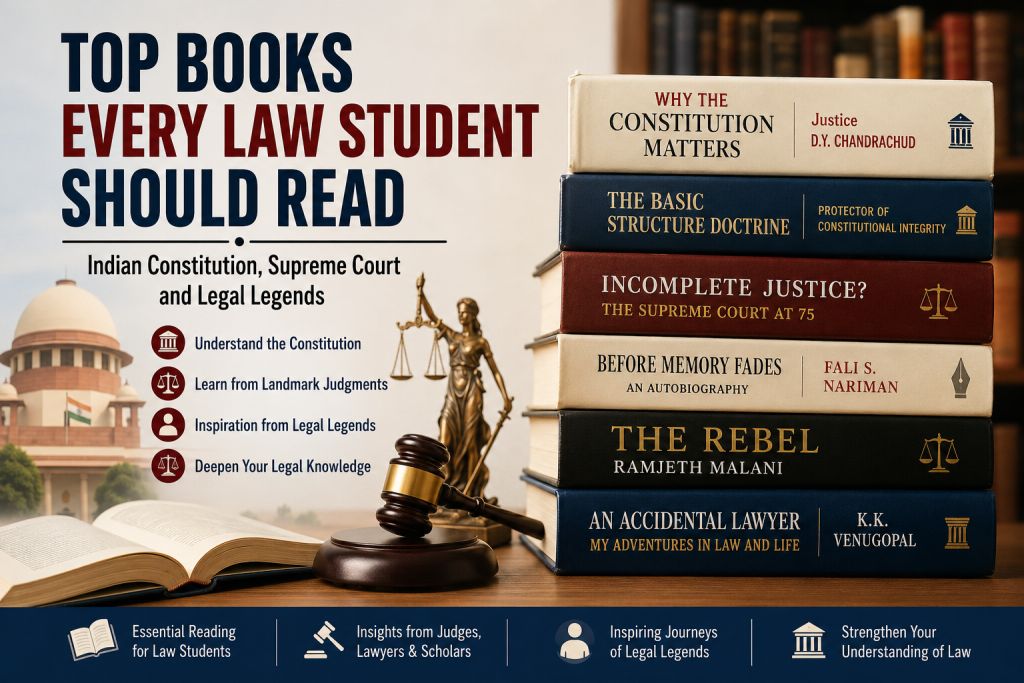
Top Books Every Lawyers Should Read: Indian Constitution, Supreme Court and Legal Legends
Legal EducationTable of Contents
ToggleThe study of law extends far beyond statutes, case laws, and courtroom procedures. To truly understand the legal system, one must explore the ideas, personalities, and constitutional principles that have shaped it. Books written by judges, legal scholars, and eminent advocates offer valuable insights into the evolution of the Indian legal system and its role in safeguarding democracy.
For law students, legal professionals, and anyone interested in constitutional governance, certain books stand out as essential reading. They not only explain legal concepts but also provide a deeper understanding of justice, constitutional values, judicial accountability, and the lives of some of India’s greatest legal minds.
1. Understanding the Importance of the Constitution
The Constitution of India is often described as the soul of the nation. It establishes the framework of governance, protects fundamental rights, and ensures the rule of law. Any serious student of law must understand not only the text of the Constitution but also the values that underpin it.
One of the most insightful works in this regard is Why the Constitution Matters by Justice D.Y. Chandrachud. Through a collection of speeches and reflections, the book explains how constitutional principles influence the everyday lives of citizens. It highlights important themes such as democracy, freedom of speech, equality, environmental protection, gender justice, and the importance of dissent in a democratic society.
What makes this work particularly valuable is its accessibility. Constitutional concepts that often appear complex become easier to understand through practical examples and real-life experiences. The book demonstrates that the Constitution is not merely a legal document but a living instrument that guides the nation toward justice and equality.
2. The Basic Structure Doctrine and Constitutional Protection
Among the most significant developments in Indian constitutional law is the Basic Structure Doctrine. This doctrine ensures that while Parliament possesses the power to amend the Constitution, it cannot alter its essential features.
A detailed study of this doctrine reveals how constitutional safeguards prevent the concentration of unlimited power in any branch of government. The doctrine emerged as a judicial mechanism to preserve the core values of the Constitution and protect democratic governance.
The significance of the Basic Structure Doctrine lies in its role as a constitutional safeguard. It ensures that principles such as democracy, secularism, judicial independence, federalism, and the rule of law remain protected even when constitutional amendments are introduced.
For students of constitutional law, understanding this doctrine is crucial because it illustrates the delicate balance between parliamentary sovereignty and constitutional supremacy. It also highlights the judiciary’s role in preserving the constitutional framework against arbitrary changes.
3. Reflecting on the Supreme Court’s Journey
The Supreme Court of India occupies a unique position in the country’s democratic structure. As the guardian of the Constitution, it has delivered numerous landmark judgments that have transformed Indian society.
The book Incomplete Justice? The Supreme Court at 75 encourages readers to critically examine the institution’s achievements and challenges. It raises important questions regarding judicial accountability, transparency, constitutional interpretation, and the balance between judicial activism and judicial restraint.
The collection brings together perspectives from judges, advocates, scholars, researchers, and journalists. Their contributions provide a multifaceted analysis of how the Court has evolved over the decades and how it continues to shape public policy and constitutional governance.
One of the central themes explored is whether the Court has successfully fulfilled its role as a protector of minority rights and constitutional values. The discussions also examine how effectively the judiciary has resisted majoritarian pressures and safeguarded individual liberties.
For law students, this book serves as an invitation to engage critically with the functioning of one of the nation’s most important institutions.
4. Learning from the Life of Fali S. Nariman
Legal education is not limited to legal doctrines and statutes. The experiences of great lawyers often provide equally valuable lessons.
Fali S. Nariman, one of India’s most respected constitutional experts, offers such lessons in his autobiography Before Memory Fades. The book chronicles his remarkable journey from his early years to becoming one of the country’s most influential legal figures.
Through personal stories and professional experiences, Nariman provides readers with a rare glimpse into the workings of the legal profession. His reflections on constitutional values, judicial independence, and ethical advocacy remain highly relevant today.
Particularly noteworthy is his decision to resign as Additional Solicitor General during the Emergency, demonstrating his commitment to constitutional principles over political convenience. His candid discussion of controversial cases and public debates also offers valuable insights into the challenges faced by legal professionals.
The autobiography stands as both a personal memoir and a historical account of India’s legal and political development.
5. The Extraordinary Career of Ram Jethmalani
Few lawyers have generated as much admiration and controversy as Ram Jethmalani. Known for his fearless advocacy and willingness to take on difficult cases, he became one of the most recognizable figures in Indian legal history.
The Rebel: A Biography of Ram Jethmalani explores the many dimensions of his remarkable life. Beyond his courtroom achievements, the book examines his contributions to legal education, public life, and political discourse.
Jethmalani’s career reflects the importance of independent thinking and intellectual courage. He was known for defending unpopular clients while consistently emphasizing the principle that every individual deserves competent legal representation.
His life story also demonstrates how legal professionals can influence public policy, contribute to institutional development, and participate actively in democratic governance.
For aspiring lawyers, his career serves as an example of dedication, resilience, and professional independence.
6. K.K. Venugopal and the Evolution of Constitutional Law
Another towering figure in Indian legal history is K.K. Venugopal. Widely regarded as one of India’s finest constitutional lawyers, his contributions have significantly influenced the development of constitutional jurisprudence.
In An Accidental Lawyer: My Adventures in Law and Life, Venugopal recounts both his professional journey and personal experiences. The book provides a fascinating account of major constitutional cases, interactions with political leaders, and observations on India’s changing legal landscape.
What makes the autobiography particularly engaging is its blend of legal history and personal storytelling. Readers gain insight into the practical realities of legal practice while also learning about the broader constitutional issues that shaped modern India.
The work offers valuable lessons on advocacy, professional ethics, courtroom strategy, and the relationship between law and governance.
For young lawyers and law students, the book serves as both an educational resource and a source of inspiration.
7. Why These Books Matter
Legal education is most effective when it combines theoretical knowledge with practical understanding. The books discussed above achieve this balance by exploring constitutional principles, judicial developments, and the personal experiences of distinguished legal professionals.
Together, they help readers understand:
- The significance of constitutional values.
- The role of the judiciary in a democracy.
- The importance of judicial independence.
- The development of constitutional doctrines.
- The ethical responsibilities of legal professionals.
- The relationship between law, politics, and society.
These works remind us that law is not merely a collection of rules. It is a dynamic system designed to promote justice, protect rights, and maintain social order.
Conclusion
The Indian legal system has been shaped by visionary judges, distinguished advocates, and transformative constitutional principles. Reading about their ideas and experiences provides a deeper appreciation of the law’s role in society.
Whether one is a law student, practicing advocate, academic researcher, or simply a citizen interested in constitutional governance, these books offer invaluable insights. They illuminate the evolution of Indian democracy, the challenges faced by the judiciary, and the enduring importance of constitutional values.
In an age where legal awareness is increasingly important, these books serve as essential guides for understanding not only the law but also the principles of justice, liberty, equality, and democratic governance that sustain the nation.
Also Read: 10 Legal Rights Every Online Shopper Must Know in India (2026 Guide)