
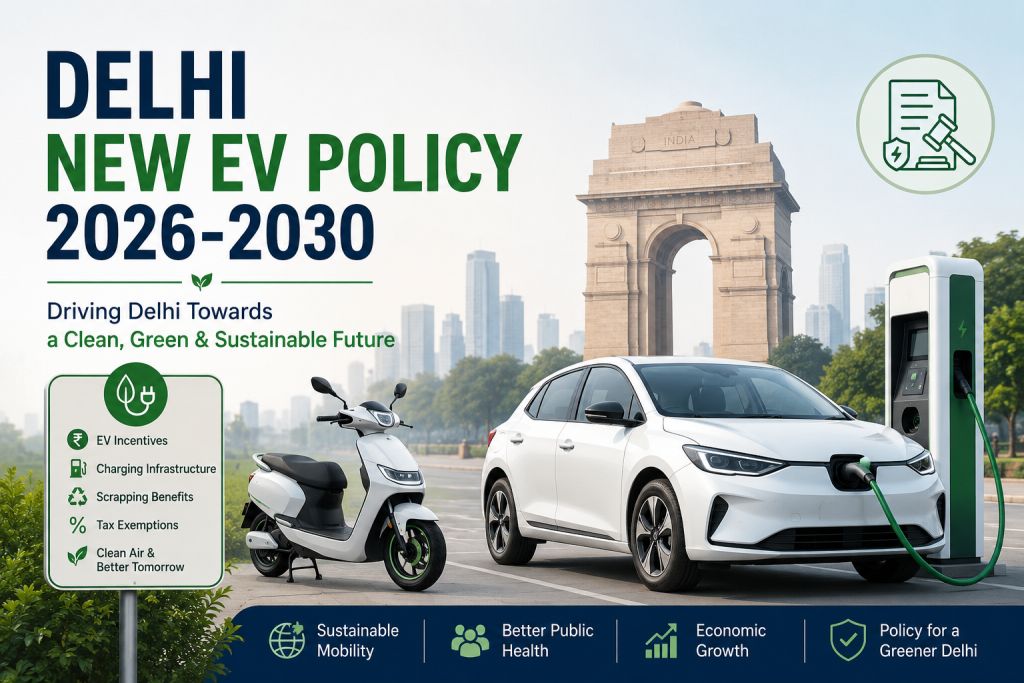
Delhi New EV Policy 2026: A New Roadmap for Clean and Sustainable Mobility
Legal EducationTable of Contents
ToggleThe Government of Delhi has introduced the Delhi Electric Vehicle (EV) Policy 2026–2030, marking a significant step towards reducing air pollution and encouraging sustainable transportation. Building upon the achievements of the earlier EV policy, the new framework aims to accelerate the adoption of electric vehicles, expand charging infrastructure, and create a comprehensive ecosystem for clean mobility.
As Delhi continues to struggle with severe air pollution, the transport sector has emerged as one of the major contributors to deteriorating air quality. The new EV policy seeks to address this challenge by promoting electric vehicles across various categories, offering financial incentives, and gradually shifting the city away from conventional fuel-powered vehicles.
Why Was the New EV Policy Introduced?
According to studies on air quality in Delhi, vehicular emissions contribute significantly to pollution levels, especially during winter months. Two-wheelers account for a large share of the total vehicles on Delhi roads, while commercial vehicles and three-wheelers contribute disproportionately to urban emissions due to their high daily usage.
The Delhi EV Policy 2026 has been designed to:
- Improve air quality and public health.
- Encourage the adoption of electric vehicles.
- Reduce dependence on petrol and diesel vehicles.
- Develop charging and battery-swapping infrastructure.
- Promote battery recycling and sustainable waste management.
- Support India’s broader environmental and climate goals.
The policy will remain effective until 31 March 2030, unless modified or extended by the government.
Major Objectives of the Delhi EV Policy 2026
The policy focuses on several key goals:
1. Faster Adoption of Electric Vehicles
The government aims to increase the number of electric vehicles across major transport segments, including two-wheelers, three-wheelers, goods carriers, and government fleets.
2. Expansion of Charging Infrastructure
A robust network of public, private, and community charging stations is planned to ensure convenient charging facilities throughout Delhi.
3. Development of EV Ecosystem
The policy supports battery recycling, component recovery, servicing facilities, and technological innovation related to electric mobility.
4. Reduction of Air Pollution
By replacing internal combustion engine (ICE) vehicles with electric alternatives, the policy seeks to reduce harmful emissions and improve Delhi’s air quality.
Financial Incentives for Electric Vehicle Buyers
One of the most attractive aspects of the policy is the range of incentives available for EV purchasers.
Incentives for Electric Two-Wheelers
Electric two-wheelers with an ex-factory price of up to Rs. 2.25 lakh are eligible for subsidies.
Year 1:
- Rs. 10,000 per kWh
- Maximum subsidy: Rs. 30,000
Year 2:
- Rs. 6,600 per kWh
- Maximum subsidy: Rs. 20,000
Year 3:
- Rs.3,300 per kWh
- Maximum subsidy: Rs. 10,000
This phased structure encourages early adoption of electric scooters and motorcycles.
Incentives for Electric Auto-Rickshaws
Electric auto-rickshaws replacing old CNG autos or newly registered autos with permits in Delhi can receive:
- Rs.50,000 in Year 1
- Rs.40,000 in Year 2
- Rs.30,000 in Year 3
Incentives for Electric Goods Vehicles
Electric N1 category goods carriers are eligible for:
- Rs.1,00,000 in Year 1
- Rs.75,000 in Year 2
- Rs.50,000 in Year 3
These incentives are expected to encourage commercial operators to transition towards cleaner transportation.
Scrapping Incentives for Old Vehicles
To remove older and more polluting vehicles from the roads, the policy introduces scrapping benefits.
Electric Two-Wheelers
Owners scrapping BS-IV or older two-wheelers can receive an additional Rs. 10,000 when purchasing a new electric vehicle.
Electric Three-Wheelers
A scrapping incentive of Rs. 25,000 is available for replacing eligible old three-wheelers with electric alternatives.
Electric Cars
Owners scrapping eligible BS-IV or older cars can receive up to Rs.1,00,000 while purchasing a new electric car priced below Rs.30 lakh.
Electric Goods Carriers
For eligible N1 trucks, a scrapping incentive of Rs.50,000 is available.
These incentives aim to accelerate the retirement of older vehicles and reduce pollution levels.
Road Tax and Registration Fee Benefits
The Delhi Government has proposed significant tax benefits for EV buyers.
Complete Exemption
Most electric vehicles registered during the policy period will enjoy:
- 100% exemption from road tax
- 100% exemption from registration fees
Benefits for Electric Cars
Electric cars priced up to Rs.30 lakh will continue to enjoy full exemptions until March 2030.
Strong Hybrid Electric Vehicles may receive partial benefits, including reduced tax liability.
These exemptions make EV ownership more affordable and attractive.
Massive Expansion of Charging Infrastructure
A successful EV ecosystem requires convenient charging facilities. The policy emphasizes large-scale development of charging and battery-swapping stations.
Key Measures Include:
- Installation of public charging stations across Delhi.
- Community charging facilities in residential areas.
- Battery-swapping stations for faster vehicle turnaround.
- Single-window approval systems for charging operators.
- Digital platforms for infrastructure management and monitoring.
The Delhi Transco Limited (DTL) has been designated as the nodal agency responsible for planning and coordinating charging infrastructure development.
Role of Vehicle Manufacturers
Vehicle manufacturers and dealers will play an important role under the new policy.
The government expects manufacturers to:
- Ensure sufficient availability of EV models.
- Stabilize vehicle prices.
- Support charging infrastructure.
Each dealer is expected to establish at least one public charging station with multiple charging points for two-wheelers, three-wheelers, and four-wheelers.
Battery Recycling and Environmental Sustainability
The policy recognizes that electric mobility must also address battery waste management.
To achieve this, the government plans to:
- Promote battery recycling facilities.
- Establish battery collection centres.
- Encourage responsible disposal practices.
- Implement battery traceability systems.
- Enforce compliance with Battery Waste Management Rules.
These measures will help create a circular economy for EV batteries and reduce environmental risks.
Mandatory Electrification Targets
Perhaps the most transformative feature of the policy is the gradual shift toward mandatory electrification.
Three-Wheelers
From 1 January 2027, only electric three-wheelers will be allowed for new registration in Delhi.
Two-Wheelers
From 1 April 2028, only electric two-wheelers will be permitted for new registration.
School Buses
Schools will be required to increase the proportion of electric buses in their fleets:
- 10% by Year 2
- 20% by Year 3
- 30% by March 2030
Government Vehicles
All newly hired or leased vehicles by Delhi Government departments will be electric, except certain exempted categories.
Additionally, all new intra-state buses purchased by government agencies are expected to be electric.
Digital and Transparent Governance
The policy promotes a fully digital implementation framework. Applications, approvals, subsidy disbursements, reporting, and grievance redressal mechanisms will be handled electronically.
This approach is expected to improve transparency, reduce paperwork, and speed up service delivery.
Expected Impact of the Delhi EV Policy
The Delhi EV Policy 2026 has the potential to transform urban transportation in the national capital. By combining financial incentives, tax exemptions, charging infrastructure development, and mandatory electrification targets, the government aims to create a cleaner and more sustainable mobility ecosystem.
The policy is likely to:
- Increase EV adoption significantly.
- Reduce vehicular emissions.
- Improve public health outcomes.
- Generate employment opportunities in the EV sector.
- Encourage investment in charging and battery technologies.
- Support India’s transition towards green transportation.
Conclusion
The Delhi New EV Policy 2026 represents a comprehensive and forward-looking approach to sustainable transportation. With attractive subsidies, scrapping incentives, extensive charging infrastructure plans, and ambitious electrification mandates, the policy seeks to make Delhi a leader in electric mobility.
If implemented effectively, the policy could play a crucial role in reducing pollution, enhancing energy efficiency, and creating a cleaner future for millions of residents. For consumers, businesses, and manufacturers alike, the coming years may mark a significant shift towards an electric and environmentally responsible transport ecosystem.
Author Name:
Also Read: Top Books Every Lawyers Should Read: Indian Constitution, Supreme Court and Legal Legends