
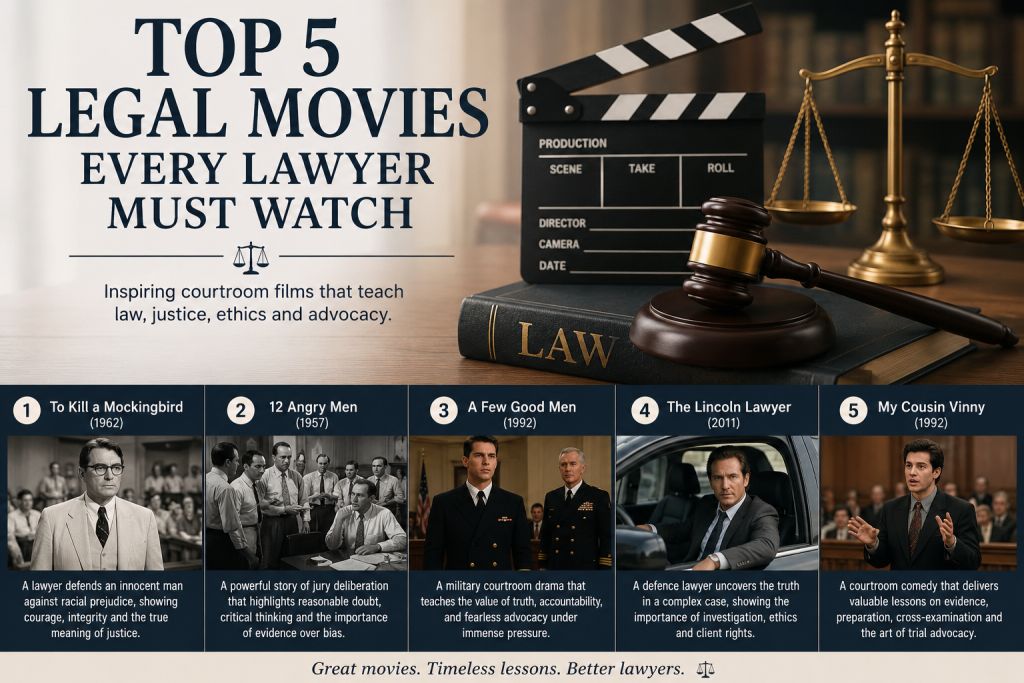
Top 5 Legal Movies Every Lawyer Must Watch: Inspiring Courtroom Films That Teach Law and Justice
Legal EducationTable of Contents
ToggleLegal education is not limited to textbooks, statutes, and judicial precedents. Some of the most valuable lessons about advocacy, ethics, justice, and courtroom strategy can also be found in well-crafted legal films. While these movies are created for entertainment, they often portray the emotional, ethical, and practical challenges faced by lawyers and judges. They remind legal professionals that every case involves real people whose lives are affected by the outcome.
Whether you are a law student, a practicing advocate, or someone interested in the justice system, the following five legal movies deserve a place on your watchlist.
1. To Kill a Mockingbird (1962)
Based on Harper Lee’s celebrated novel, To Kill a Mockingbird remains one of the greatest legal films ever made. The story follows Atticus Finch, a respected lawyer who defends an innocent Black man falsely accused of a serious crime in a society deeply influenced by racial prejudice. Despite overwhelming public pressure and widespread discrimination, Finch refuses to compromise his professional ethics or abandon his client.
The film demonstrates the true meaning of legal representation. It teaches that a lawyer’s duty extends beyond winning a case; it includes protecting constitutional rights, ensuring a fair trial, and standing against injustice even when success appears impossible. Atticus Finch carefully investigates the facts, cross-examines witnesses with dignity, and presents a compelling defence rooted in truth rather than emotion.
One of the film’s greatest strengths is its portrayal of professional integrity. Finch remains calm under criticism, treats everyone with respect, and never allows personal attacks to distract him from his responsibility. His conduct illustrates qualities that every lawyer should strive to develop, including patience, honesty, compassion, and courage.
Although the story is set decades ago, its themes remain relevant today. Issues of equality before the law, judicial fairness, and ethical advocacy continue to challenge legal systems across the world. The movie encourages lawyers to remember that the justice system depends not only on laws but also on the moral character of those who practice them.
For every advocate, To Kill a Mockingbird is far more than a courtroom drama—it is a timeless lesson in legal ethics and professional responsibility.
2. 12 Angry Men (1957)
Unlike many courtroom dramas, 12 Angry Men unfolds almost entirely inside a jury deliberation room. The story begins after the completion of a murder trial, where twelve jurors must decide whether the accused is guilty. At first, eleven jurors vote to convict, while only one juror expresses reasonable doubt and requests a careful discussion before reaching a verdict.
As the deliberations continue, assumptions are challenged, witness testimony is examined, and overlooked facts begin to emerge. The film brilliantly illustrates how logical reasoning, critical thinking, and open-minded discussion can prevent a miscarriage of justice.
For lawyers, the movie offers valuable lessons in persuasion and evidence analysis. It demonstrates that legal arguments must be based on facts rather than prejudice or emotion. Every piece of evidence should be tested, and every witness statement deserves careful scrutiny. The importance of questioning assumptions is one of the central themes throughout the film.
Another remarkable lesson is the power of respectful advocacy. The lone dissenting juror does not rely on aggression or dramatic speeches. Instead, he patiently asks questions, encourages discussion, and allows others to reconsider their positions through rational analysis. This approach closely resembles effective courtroom advocacy, where persuasion often depends on credibility and careful reasoning.
The film also highlights the principle that the burden of proof lies with the prosecution and that guilt must be established beyond reasonable doubt. These foundational legal principles make the movie particularly valuable for criminal law practitioners and students.
More than sixty years after its release, 12 Angry Men continues to be regarded as one of the finest films ever made about justice, fairness, and decision-making.
3. A Few Good Men (1992)
A Few Good Men is an engaging military courtroom drama that examines responsibility, leadership, and accountability within the armed forces. The story follows a young military lawyer assigned to defend two soldiers accused of causing the death of another serviceman during an unofficial disciplinary action.
Initially, the defence appears weak, but as the investigation progresses, hidden facts emerge that reveal the influence of superior officers and unofficial military practices. The lawyer must balance professional duty with immense institutional pressure while uncovering the truth.
The film is widely admired for its courtroom advocacy and cross-examination scenes. It demonstrates the importance of preparation, strategic questioning, and maintaining composure under pressure. Lawyers can observe how effective advocacy often depends on understanding both legal principles and human psychology.
Ethics also play a central role in the story. The lawyers face difficult decisions regarding loyalty, professional responsibility, and the pursuit of justice. The film reminds viewers that legal professionals must remain committed to the truth, even when powerful individuals attempt to obstruct justice.
Another significant lesson concerns leadership and accountability. The movie explores how authority should never excuse unlawful conduct and how legal institutions serve as an important check on the abuse of power.
For advocates, A Few Good Men provides practical insights into litigation strategy, witness examination, and ethical decision-making. Its memorable courtroom exchanges have made it one of the most respected legal dramas ever produced.
4. The Lincoln Lawyer (2011)
The Lincoln Lawyer introduces viewers to a criminal defence attorney who conducts much of his legal practice from the back seat of his car. Initially appearing to be an ordinary defence lawyer representing clients for financial gain, he soon becomes involved in a complex case that challenges both his professional judgment and personal ethics.
The story demonstrates how lawyers must independently verify every piece of evidence instead of relying solely on client instructions or police investigations. As new facts emerge, the lawyer realises that appearances can be deceptive and that thorough investigation is essential for effective representation.
The film highlights several practical aspects of criminal litigation, including client confidentiality, attorney-client privilege, negotiation, evidence collection, and courtroom strategy. It realistically portrays the difficult balance lawyers must maintain between protecting a client’s legal rights and fulfilling their ethical obligations to the justice system.
One of the movie’s strongest messages is that criminal defence lawyers play an essential role in ensuring fair trials. Representing an accused person does not mean supporting criminal conduct; rather, it ensures that legal procedures are followed and constitutional safeguards are respected.
The protagonist’s determination to uncover the truth despite significant personal risk makes the story both engaging and educational. Lawyers can appreciate how careful preparation, legal research, and strategic thinking often determine the outcome of a case.
Overall, The Lincoln Lawyer offers an entertaining yet thoughtful examination of modern criminal defence practice and professional responsibility.
5. My Cousin Vinny (1992)
Although presented as a comedy, My Cousin Vinny contains surprisingly accurate depictions of courtroom procedure and trial advocacy. The story follows an inexperienced lawyer who unexpectedly finds himself defending two young men accused of murder in a small town where he has never practised before.
Initially lacking courtroom experience, the lawyer struggles with procedural rules, judicial expectations, and local customs. However, through persistence, preparation, and creative thinking, he gradually develops into an effective advocate.
One of the film’s greatest educational strengths is its treatment of evidence and expert testimony. The lawyer successfully exposes weaknesses in the prosecution’s case by carefully questioning witnesses and presenting expert analysis. These scenes illustrate how attention to detail can significantly influence the outcome of a trial.
The movie also demonstrates that confidence alone cannot replace preparation. Success in litigation depends on understanding procedural law, mastering facts, and presenting evidence clearly before the court. Lawyers and law students can learn valuable lessons about cross-examination, witness credibility, and courtroom etiquette while enjoying the film’s humour.
Despite its light-hearted tone, the movie reinforces serious legal principles such as the presumption of innocence, the burden of proof, and the importance of competent legal representation. It reminds viewers that justice often depends on a lawyer’s willingness to challenge assumptions and investigate every detail thoroughly.
For legal professionals seeking an entertaining film with genuine courtroom lessons, My Cousin Vinny remains an outstanding choice.
Conclusion
Legal movies cannot replace formal legal education, but they can inspire lawyers to think more deeply about justice, ethics, advocacy, and professional responsibility. Each of these five films presents unique lessons—from courage in the face of prejudice to the importance of evidence, cross-examination, and ethical decision-making.
Watching these classics can improve not only courtroom understanding but also appreciation for the values that define the legal profession. Every lawyer, regardless of experience, can find practical and moral inspiration in these timeless legal
Nice Suggestions Sir