
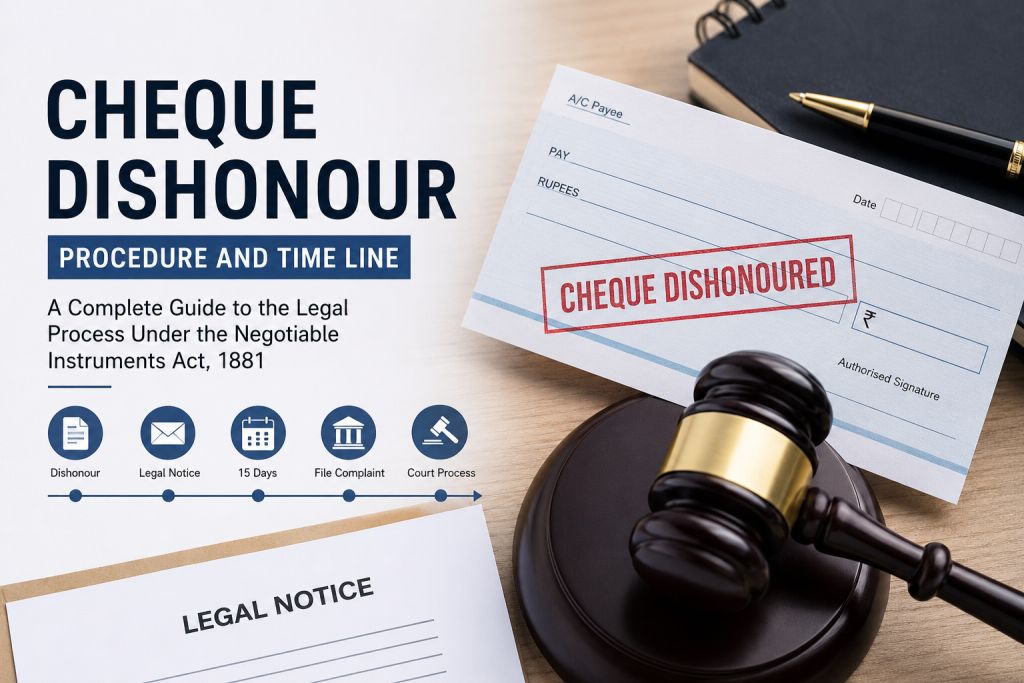
Cheque Dishonour Procedure in India: Complete Legal Timeline Under the Negotiable Instruments Act, 1881
Legal EducationTable of Contents
ToggleA cheque is one of the most widely used financial instruments for making payments in India. Whether used for business transactions, loan repayments, rent, or personal payments, a cheque represents the drawer’s promise that sufficient funds are available in the bank account. However, when a cheque is returned unpaid by the bank, it is known as cheque dishonour or cheque bounce. Such an event may lead to civil as well as criminal consequences, particularly under the Negotiable Instruments Act, 1881.
This article explains the complete legal procedure, statutory timeline, and important aspects of cheque dishonour proceedings in India.
What is Cheque Dishonour?
A cheque is said to be dishonoured when the bank refuses to honour the payment and returns it unpaid. The bank issues a Cheque Return Memo specifying the reason for dishonour.
Some common reasons include:
- Insufficient balance in the account.
- Payment stopped by the drawer.
- Signature mismatch.
- Account closed.
- Exceeds arrangement with the bank.
- Alteration in the cheque.
- Difference in words and figures.
- Stale cheque or post-dated cheque presented before its due date.
Not every dishonour results in criminal liability. Section 138 of the Negotiable Instruments Act mainly applies when the cheque is dishonoured due to insufficiency of funds or similar reasons connected with payment.
Essential Conditions for Filing a Case Under Section 138
A prosecution for cheque dishonour can be initiated only if the following conditions are fulfilled:
- The cheque must have been issued towards a legally enforceable debt or liability.
- The cheque must be presented within its validity period (currently three months from the date mentioned on the cheque).
- The cheque must be dishonoured by the bank.
- The payee must send a legal demand notice within the prescribed period.
- The drawer must fail to make payment within the statutory period after receiving the notice.
If any of these conditions are not satisfied, a complaint under Section 138 may not be maintainable.
Complete Timeline After Cheque Dishonour
Step 1: Presentation of the Cheque
The holder presents the cheque to the bank for encashment within its validity period.
Time Limit:
Within 3 months from the date of the cheque.
Step 2: Dishonour by the Bank
If the cheque cannot be honoured, the bank returns it along with a Cheque Return Memo mentioning the reason for dishonour.
The date mentioned in the return memo becomes important for calculating further legal timelines.
Step 3: Sending the Legal Demand Notice
After receiving the cheque return memo, the payee should issue a legal notice demanding payment of the cheque amount.
The notice should contain:
- Details of the cheque.
- Date of presentation.
- Reason for dishonour.
- Amount due.
- Demand for payment.
Time Limit:
The legal notice must be sent within 30 days from the date of receiving information regarding dishonour from the bank.
The notice should preferably be sent through Registered Post, Speed Post, or another mode that provides proof of delivery.
Step 4: Waiting Period for Payment
Once the drawer receives the legal notice, the law grants an opportunity to make payment voluntarily.
Time Limit:
The drawer has 15 days from the date of receipt of the notice to pay the cheque amount.
If payment is made within this period, no offence under Section 138 is committed.
Step 5: Cause of Action Arises
If the drawer fails to make payment within the 15-day period, the cause of action arises on the next day.
Only after this stage can a criminal complaint be filed before the competent Magistrate.
Step 6: Filing the Complaint
The complainant files a complaint under Section 138 before the competent court having territorial jurisdiction.
Generally, the complaint includes:
- Complaint petition.
- Original cheque.
- Cheque return memo.
- Copy of legal notice.
- Postal receipts.
- Proof of delivery or returned envelope.
- Affidavit and supporting documents.
Time Limit:
The complaint must be filed within one month from the date on which the cause of action arises.
However, the court may condone delay if sufficient reasons are shown.
Court Procedure After Filing the Complaint
Once the complaint is filed, the court generally follows these stages:
1. Preliminary Examination
The Magistrate examines the complaint and supporting documents.
2. Issuance of Summons
If the court finds sufficient grounds, summons are issued to the accused.
3. Appearance of the Accused
The accused appears before the court personally or through counsel.
4. Recording of Plea
The court records whether the accused admits or denies the allegations.
5. Evidence of the Complainant
The complainant files evidence, usually through affidavit, and produces relevant documents.
6. Cross-Examination
The accused gets an opportunity to cross-examine the complainant.
7. Defence Evidence
If required, the accused may lead defence evidence.
8. Final Arguments
Both parties present legal arguments before the court.
9. Judgment
The court delivers its judgment after considering the evidence and applicable law.
Punishment for Cheque Dishonour
If the accused is found guilty under Section 138 of the Negotiable Instruments Act, the court may impose:
- Imprisonment for up to two years; or
- Fine which may extend to twice the cheque amount; or
- Both imprisonment and fine.
The court may also award compensation to the complainant in appropriate cases.
Can the Parties Settle the Matter?
Yes. Cheque dishonour cases are compoundable in nature. This means the parties can settle the dispute even after the complaint has been filed.
Courts generally encourage amicable settlement, particularly where the drawer agrees to pay the cheque amount along with reasonable costs.
Important Documents Required
The complainant should preserve the following documents carefully:
- Original cheque.
- Bank return memo.
- Legal demand notice.
- Postal receipt.
- Delivery tracking report.
- Reply to notice, if any.
- Proof of liability, such as agreement, invoice, loan document, or account statement.
These documents play a significant role during trial.
Practical Tips for the Payee
- Present the cheque before its validity expires.
- Preserve the cheque return memo safely.
- Do not delay sending the legal notice.
- Ensure that the notice is correctly addressed.
- Maintain complete records of postal dispatch and delivery.
- File the complaint within the prescribed limitation period.
- Keep documentary evidence establishing the underlying debt or liability.
Practical Tips for the Drawer
- Maintain sufficient balance before issuing a cheque.
- Avoid issuing blank signed cheques unless absolutely necessary.
- Respond promptly to any legal notice.
- If liability is admitted, consider settling the matter during the statutory notice period.
- Preserve records relating to payments and financial transactions.
Conclusion
Cheque dishonour proceedings follow a strict statutory timeline, and every stage has legal significance. From presenting the cheque to filing the complaint, missing even one prescribed time limit may adversely affect the legal remedy available to the payee. Likewise, the drawer has a valuable opportunity to avoid criminal prosecution by making payment within fifteen days of receiving the legal notice.
Understanding the complete procedure helps both parties protect their legal rights and comply with the requirements of the Negotiable Instruments Act, 1881. Whether you are a business owner, lender, professional, or individual, maintaining proper documentation and adhering to the prescribed timeline is the key to effectively handling cheque dishonour disputes.
Acha laga
Good l.k ji