
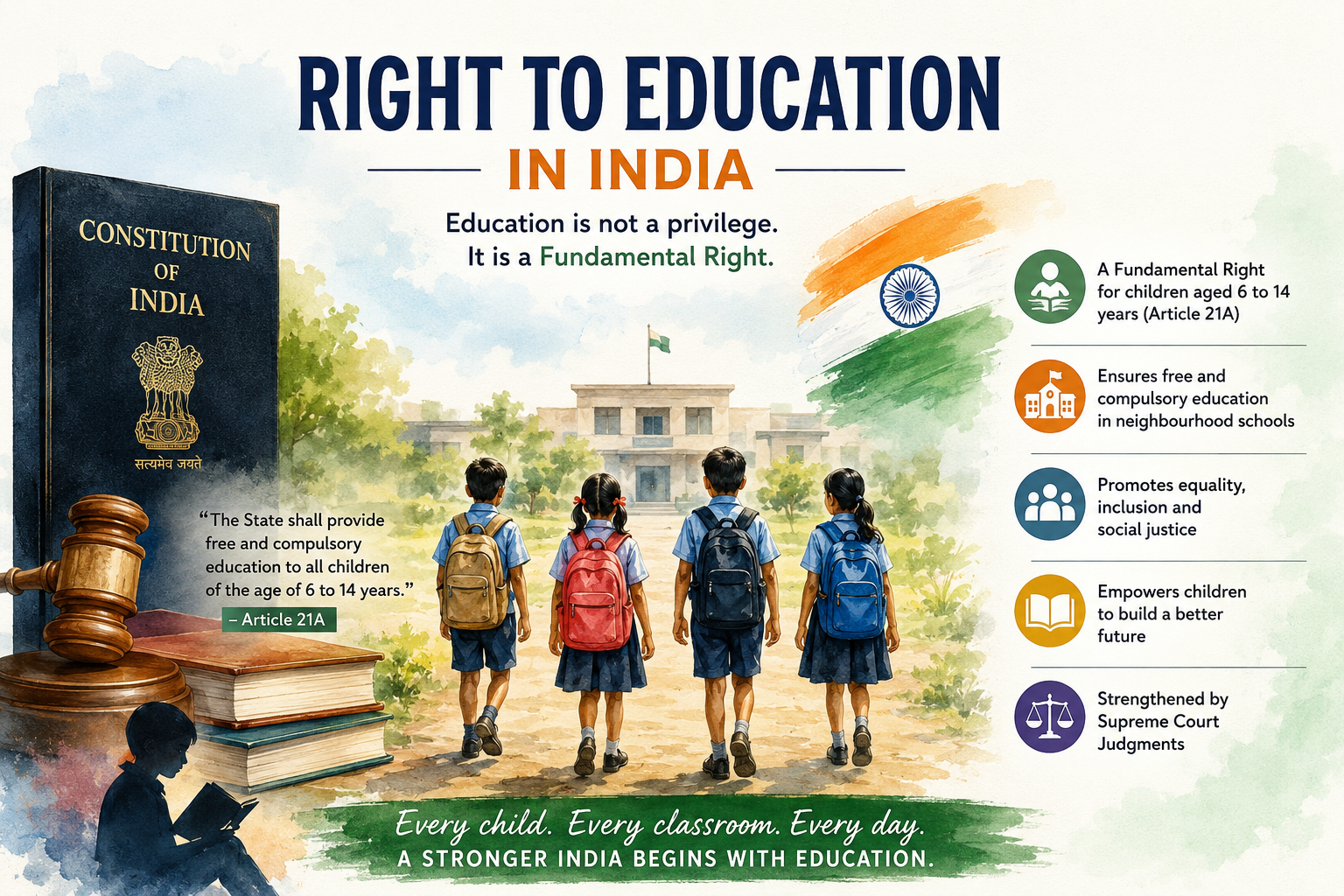
Right to Education in India: A Constitutional Promise for Every Child
Legal Eduation, Uncategorized
Education is the foundation of a progressive and democratic society. It empowers individuals, promotes social equality, strengthens the economy, and enables citizens to participate effectively in governance. Recognizing the vital importance of education, India has elevated the Right to Education (RTE) to the status of a Fundamental Right under the Constitution.
The Right to Education is not merely a legal entitlement; it is a powerful instrument for social transformation. It seeks to ensure that every child, irrespective of caste, religion, gender, economic status, or geographical location, has access to quality elementary education. This article explores the constitutional framework, legislative developments, and landmark judicial decisions that have shaped the Right to Education in India.
Constitutional Basis of the Right to Education
At the time of the adoption of the Constitution in 1950, the right to education was not included among the Fundamental Rights. Instead, it was incorporated under the Directive Principles of State Policy.
Article 45
Originally, Article 45 directed the State to provide free and compulsory education to all children up to the age of fourteen years within ten years from the commencement of the Constitution.
However, due to various administrative and financial challenges, this objective could not be fully achieved for several decades.
Article 21 and Judicial Interpretation
The turning point came when the Supreme Court interpreted the Right to Education as an integral part of the Right to Life guaranteed under Article 21 of the Constitution. Through a series of landmark judgments, the Court recognized that a meaningful life and human dignity are impossible without education.
The 86th Constitutional Amendment, 2002
To give constitutional recognition to this principle, Parliament enacted the Constitution (Eighty-Sixth Amendment) Act, 2002.
The amendment introduced:
- Article 21A – Making free and compulsory education a Fundamental Right for all children between the ages of 6 and 14 years.
- Modified Article 45 – Directing the State to provide early childhood care and education for children below six years.
- Article 51A(k) – Making it a fundamental duty of parents and guardians to provide educational opportunities to children between 6 and 14 years of age.
Article 21A states:
“The State shall provide free and compulsory education to all children of the age of six to fourteen years in such manner as the State may, by law, determine.”
The Right of Children to Free and Compulsory Education Act, 2009
To implement Article 21A, Parliament enacted the Right of Children to Free and Compulsory Education Act, 2009 (RTE Act), which came into force on 1 April 2010.
The Act aims to ensure that every child receives elementary education without financial or social barriers.
Key Features of the RTE Act
1. Free and Compulsory Education
Every child aged 6 to 14 years is entitled to free education in a neighbourhood school. No child can be required to pay fees or charges that may prevent completion of elementary education.
2. Non-Discrimination
Schools cannot deny admission on the basis of caste, religion, gender, disability, or economic status.
3. 25% Reservation in Private Schools
Private unaided schools are required to reserve 25% of seats at the entry level for children belonging to weaker sections and disadvantaged groups.
4. Prohibition of Capitation Fee and Screening
Schools are prohibited from collecting capitation fees or conducting admission tests and interviews for young children.
5. Child-Friendly Education
The Act promotes a child-centred learning environment and discourages physical punishment and mental harassment.
6. Infrastructure and Teacher Standards
The law prescribes minimum standards relating to classrooms, sanitation facilities, teacher qualifications, and pupil-teacher ratios.
Landmark Supreme Court Judgments
1. Mohini Jain v. State of Karnataka (1992)
Citation: (1992) 3 SCC 666
This case arose from the practice of charging exorbitant capitation fees by private educational institutions.
The Supreme Court held that the Right to Education flows directly from the Right to Life under Article 21. The Court observed that without education, the dignity and development of an individual cannot be achieved. This was the first major decision recognizing education as a fundamental constitutional value.
2. Unni Krishnan, J.P. v. State of Andhra Pradesh (1993)
Citation: (1993) 1 SCC 645
This judgment refined the principle laid down in Mohini Jain.
The Supreme Court held that the Right to Education is a Fundamental Right under Article 21, particularly for children up to the age of 14 years. The Court clarified that the State’s obligation beyond that age would depend upon its economic capacity and development. This decision ultimately laid the foundation for Article 21A.
3. Society for Unaided Private Schools of Rajasthan v. Union of India (2012)
Citation: (2012) 6 SCC 1
The Supreme Court upheld the constitutional validity of the RTE Act and the requirement that private unaided schools reserve 25% of seats for children from weaker sections of society. The Court held that the provision advances the constitutional goal of social justice and inclusive education.
4. Pramati Educational and Cultural Trust v. Union of India (2014)
Citation: (2014) 8 SCC 1
The Supreme Court held that minority educational institutions are exempt from certain obligations under the RTE Act in order to protect their constitutional rights under Articles 29 and 30.
5. Avinash Mehrotra v. Union of India (2009)
Citation: (2009) 6 SCC 398
The Court emphasized that the Right to Education includes the right to a safe educational environment. It directed authorities to ensure compliance with safety standards in schools to protect children from avoidable hazards.
Importance of the Right to Education
The Right to Education serves several important constitutional and social objectives:
- Promotes equality and social justice.
- Reduces poverty and unemployment.
- Empowers marginalized communities.
- Enhances democratic participation.
- Prevents child labour and exploitation.
- Encourages gender equality.
- Strengthens national development and economic growth.
An educated population contributes significantly to innovation, productivity, and responsible citizenship.
Challenges in Implementation
Despite remarkable progress, several challenges continue to affect the effective implementation of the Right to Education:
1. School Dropout Rates
Many children discontinue education due to poverty, migration, child labour, or family responsibilities.
2. Infrastructure Deficiencies
Several schools still lack adequate classrooms, libraries, laboratories, and sanitation facilities.
3. Teacher Shortage
Many educational institutions face shortages of trained and qualified teachers.
4. Quality of Education
Access to education has improved, but concerns remain regarding learning outcomes and educational quality.
5. Digital Divide
The increasing use of technology in education has highlighted disparities in access to internet services and digital devices, particularly in rural areas.
Conclusion
The Right to Education represents one of the most significant achievements of Indian constitutional democracy. From being a Directive Principle to becoming a Fundamental Right under Article 21A, the journey of educational rights in India reflects the growing recognition that education is essential for human dignity and national progress.
The Supreme Court has played a crucial role in transforming education from a policy objective into an enforceable constitutional guarantee. Through landmark decisions such as Mohini Jain and Unni Krishnan, the judiciary laid the foundation for the constitutional and legislative framework that exists today.
While challenges remain, the Right to Education continues to be a powerful tool for achieving equality, social justice, and inclusive development. Ensuring quality education for every child is not merely a constitutional obligation—it is an investment in the future of India.