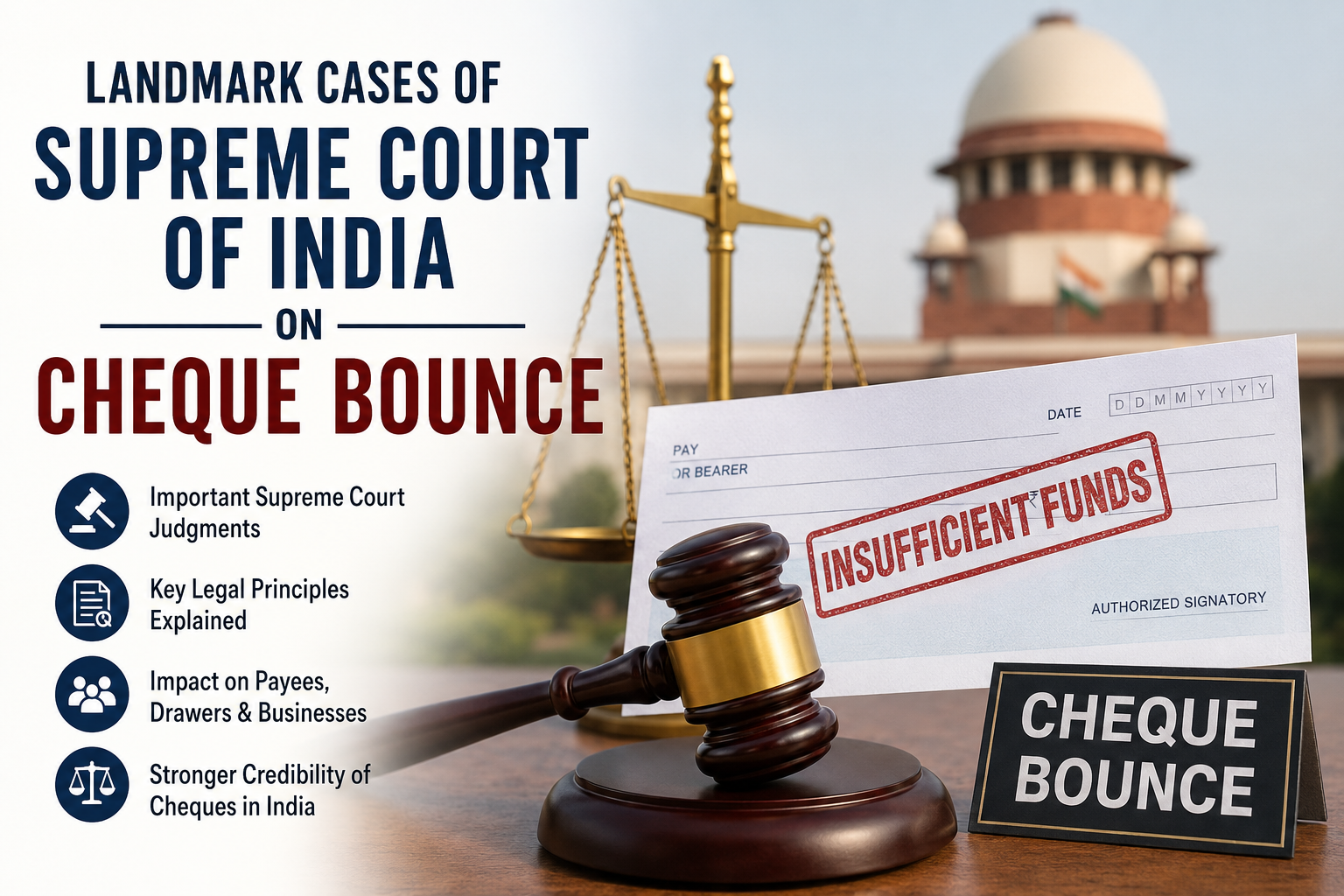
10 Landmark Case on Cheque Bounce
Legal Eduation case of cheque bounce, check bounce
Introduction
The use of cheques remains an important mode of financial transaction in India despite the rise of digital payments. To ensure trust and credibility in commercial dealings, the legislature introduced stringent provisions against cheque dishonour under the Negotiable Instruments Act, 1881. Section 138 of the Act makes the dishonour of a cheque for insufficiency of funds a criminal offence, subject to fulfillment of certain statutory conditions.
Over the years, the Supreme Court of India has delivered several landmark judgments interpreting and clarifying the provisions relating to cheque bounce cases. These decisions have shaped the legal framework governing cheque dishonour and have ensured a balance between the rights of the payee and the drawer.
This article discusses some of the most significant Supreme Court judgments on cheque bounce cases.
1. K. Bhaskaran v. Sankaran Vaidhyan Balan (1999)
Citation:
(1999) 7 SCC 510
Importance of the Case
This is one of the earliest and most influential judgments on Section 138 of the Negotiable Instruments Act.
The Supreme Court identified five essential components of the offence of cheque dishonour:
- Drawing of the cheque.
- Presentation of the cheque to the bank.
- Return of the cheque unpaid.
- Issuance of a statutory demand notice.
- Failure of the drawer to make payment within the prescribed period.
The Court held that jurisdiction could lie at any place where one of these components occurred. This judgment significantly expanded territorial jurisdiction in cheque bounce cases.
Significance
The decision made it easier for complainants to institute proceedings and remained the governing law for several years.
2. Dashrath Rupsingh Rathod v. State of Maharashtra (2014)
Citation:
(2014) 9 SCC 129
Importance of the Case
In this landmark judgment, the Supreme Court revisited the issue of territorial jurisdiction.
The Court held that a complaint under Section 138 can be filed only before the court within whose jurisdiction the drawee bank (the bank of the drawer) is situated.
This judgment overruled the wider jurisdiction principle laid down in K. Bhaskaran.
Significance
The ruling aimed to prevent harassment of accused persons by restricting jurisdiction. However, it created practical difficulties for complainants, leading to legislative intervention.
3. Bridgestone India Pvt. Ltd. v. Inderpal Singh (2016)
Citation:
(2016) 2 SCC 75
Importance of the Case
Following the enactment of the Negotiable Instruments (Amendment) Act, 2015, the Supreme Court clarified the position regarding territorial jurisdiction.
The Court held that where a cheque is deposited for collection through an account, the court having jurisdiction over the bank branch where the payee maintains the account would have jurisdiction.
Significance
This judgment restored convenience for payees and aligned judicial interpretation with legislative intent.
4. Rangappa v. Sri Mohan (2010)
Citation:
(2010) 11 SCC 441
Importance of the Case
This judgment dealt with the presumption under Section 139 of the Negotiable Instruments Act.
The Supreme Court held that once the execution of the cheque is admitted, there is a legal presumption that the cheque was issued towards a legally enforceable debt or liability.
The burden then shifts to the accused to rebut this presumption.
Significance
The decision strengthened the position of cheque holders and clarified the evidentiary burden in cheque dishonour cases.
5. M.S. Narayana Menon v. State of Kerala (2006)
Citation:
(2006) 6 SCC 39
Importance of the Case
The Court examined the manner in which an accused can rebut the statutory presumption under Sections 118 and 139 of the Act.
The Supreme Court held that the accused is not required to prove his defence beyond reasonable doubt. He can rebut the presumption on the basis of a preponderance of probabilities.
Significance
The judgment protected the rights of the accused by ensuring that the statutory presumption does not become irrebuttable.
6. C.C. Alavi Haji v. Palapetty Muhammed (2007)
Citation:
(2007) 6 SCC 555
Importance of the Case
The Court dealt with the issue of service of legal notice.
It held that where a notice is properly addressed and dispatched by registered post, service may be presumed even if the accused denies actual receipt.
The Court further observed that a person who receives summons from the court can still make payment within fifteen days and seek dismissal of the complaint.
Significance
This judgment prevented dishonest drawers from avoiding liability by deliberately refusing or evading notices.
7. Indian Bank Association v. Union of India (2014)
Citation:
(2014) 5 SCC 590
Importance of the Case
Cheque bounce cases constitute a substantial portion of criminal litigation in India.
To address delays, the Supreme Court issued several procedural directions, including:
- Early scrutiny of complaints.
- Use of affidavits as evidence.
- Speedy issuance of summons.
- Adoption of summary trial procedures.
Significance
The judgment aimed to reduce backlog and ensure quicker disposal of cheque dishonour cases.
8. A.C. Narayanan v. State of Maharashtra (2014)
Citation:
(2014) 11 SCC 790
Importance of the Case
The Supreme Court considered whether a complaint under Section 138 can be filed through a power of attorney holder.
The Court held that such complaints are maintainable provided the power of attorney holder has personal knowledge of the transaction and is properly authorized.
Significance
This decision is particularly important for companies, firms, and business entities that conduct transactions through representatives.
9. Bir Singh v. Mukesh Kumar (2019)
Citation:
(2019) 4 SCC 197
Importance of the Case
The Court addressed the issue of blank signed cheques.
It held that even if a cheque is signed and handed over blank, the holder may fill in the particulars. The mere fact that the cheque was blank at the time of signing does not invalidate it.
Significance
The judgment strengthened the credibility of signed cheques and prevented misuse of technical defences.
10. Meters and Instruments Pvt. Ltd. v. Kanchan Mehta (2018)
Citation:
(2018) 1 SCC 560
Importance of the Case
The Supreme Court emphasized the compensatory nature of cheque dishonour proceedings.
The Court encouraged compounding of offences and settlement between parties at an early stage.
Significance
The decision promoted speedy resolution and reduced unnecessary criminal litigation.
Conclusion
Cheque dishonour litigation has evolved significantly through judicial interpretation by the Supreme Court of India. Landmark judgments such as K. Bhaskaran, Rangappa, C.C. Alavi Haji, Bir Singh, and A.C. Narayanan have clarified critical aspects relating to jurisdiction, statutory presumptions, service of notice, blank cheques, and filing of complaints through authorized representatives.
These decisions collectively reinforce the objective of Section 138 of the Negotiable Instruments Act, namely, maintaining confidence in commercial transactions and ensuring the credibility of cheques as a negotiable instrument. For litigants, lawyers, businesses, and financial institutions, understanding these landmark rulings is essential for effectively navigating cheque bounce disputes in India.