
Right to Information in India: Empowering Citizens Through Transparency
Uncategorized
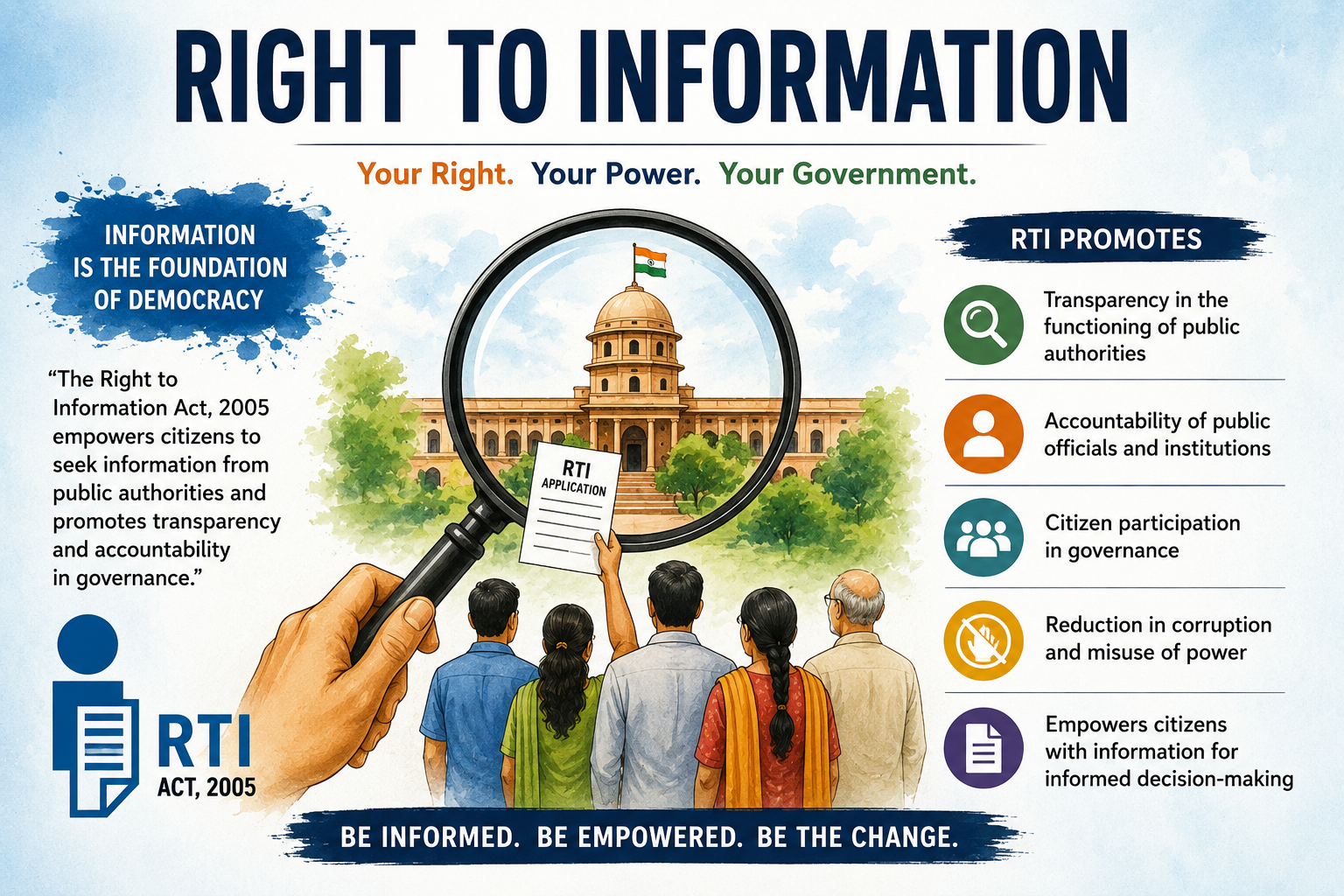
The Right to Information (RTI) is one of the most significant democratic reforms in modern India. It empowers citizens to seek information from public authorities, promotes transparency in governance, and helps hold public officials accountable for their actions. In a democracy, information is power, and the Right to Information ensures that this power is not confined to government offices but is accessible to every citizen.
The enactment of the Right to Information Act, 2005 marked a historic step towards open governance in India. The Act recognizes that transparency and accountability are essential for preventing corruption, strengthening public participation, and ensuring good governance.
This article explores the constitutional foundation, key provisions, significance, challenges, and landmark judicial decisions relating to the Right to Information in India.
Constitutional Basis of the Right to Information
The Constitution of India does not expressly mention the Right to Information as a Fundamental Right. However, the Supreme Court has consistently held that the right to know is an integral part of the freedom of speech and expression guaranteed under Article 19(1)(a) of the Constitution.
The logic behind this interpretation is simple: a citizen cannot effectively exercise freedom of speech and expression unless he or she has access to relevant information. An informed citizenry is essential for the functioning of a democratic society.
The judiciary gradually developed the concept of the “right to know” through various landmark decisions, which ultimately paved the way for the enactment of the RTI Act, 2005.
Historical Development of RTI in India
The movement for transparency gained momentum during the 1990s through the efforts of civil society organizations and activists who demanded access to government records relating to public expenditure and development projects.
Recognizing the growing demand for transparency and accountability, Parliament enacted the Right to Information Act, 2005. The Act came into force on 12 October 2005 and applies throughout India, subject to certain statutory exemptions.
The RTI Act transformed the relationship between citizens and the government by replacing the traditional culture of secrecy with a legal framework favouring disclosure.
Objectives of the RTI Act, 2005
The primary objectives of the Act are:
- To promote transparency in the functioning of public authorities.
- To ensure accountability of government institutions.
- To reduce corruption and misuse of public resources.
- To strengthen democratic participation.
- To empower citizens with information concerning public affairs.
- To improve governance through public scrutiny.
The Act recognizes that informed citizens are better equipped to participate in democratic processes and monitor government functioning.
Key Features of the RTI Act
1. Right to Seek Information
Any citizen of India may request information from a public authority.
2. Public Authorities Covered
The Act applies to:
- Central Government departments
- State Government departments
- Local authorities
- Public sector undertakings
- Constitutional bodies
- Government-funded institutions
- Non-government organizations substantially financed by the government
3. Time Limit for Providing Information
Generally, information must be provided within 30 days of receiving the application.
Where the information concerns life or liberty of a person, it must be supplied within 48 hours.
4. Appointment of Information Officers
Every public authority is required to designate Public Information Officers (PIOs) to receive and process RTI applications.
5. Appeal Mechanism
If information is denied or delayed, the applicant may file:
- First Appeal before the First Appellate Authority.
- Second Appeal before the Central or State Information Commission.
6. Penalties
The Information Commission may impose penalties upon officials who unjustifiably refuse or delay disclosure of information.
Information Exempted from Disclosure
The RTI Act is not absolute. Certain categories of information are exempt from disclosure under Section 8 of the Act, including:
- Information affecting national security.
- Information relating to foreign relations.
- Cabinet papers in certain circumstances.
- Trade secrets and intellectual property.
- Personal information where disclosure would invade privacy.
- Information that may impede investigation or prosecution.
These exemptions seek to balance transparency with legitimate public interests.
Landmark Supreme Court Judgments
1. State of Uttar Pradesh v. Raj Narain (1975)
Citation: (1975) 4 SCC 428
This is one of the earliest and most important cases concerning the right to know.
The Supreme Court held that citizens have a right to know how their government functions. The Court observed that in a democratic system, government secrecy should be the exception and transparency should be the rule. This judgment laid the constitutional foundation for the future Right to Information regime.
2. S.P. Gupta v. Union of India (1981)
Citation: 1981 Supp SCC 87
Popularly known as the Judges’ Transfer Case, the Supreme Court emphasized that open government is the hallmark of a democratic society.
The Court declared that the people have a right to know every public act performed by public authorities. This judgment significantly expanded the scope of transparency in governance.
3. People’s Union for Civil Liberties (PUCL) v. Union of India (2003)
Citation: (2003) 4 SCC 399
The Supreme Court held that voters have a right to know the criminal background, assets, liabilities, and educational qualifications of electoral candidates.
The judgment recognized that informed voting is an essential component of democracy and strengthened the constitutional basis of the right to information.
4. CBSE v. Aditya Bandopadhyay (2011)
Citation: (2011) 8 SCC 497
The Supreme Court ruled that students are entitled to inspect and obtain copies of their evaluated answer sheets under the RTI Act.
The Court emphasized that transparency in educational institutions enhances fairness and accountability.
5. CPIO, Supreme Court of India v. Subhash Chandra Agarwal (2020)
Citation: (2020) 5 SCC 481
A Constitution Bench held that the Office of the Chief Justice of India is a “public authority” under the RTI Act.
The judgment reinforced the principle that transparency applies even to the higher judiciary, while simultaneously balancing privacy and institutional independence.
Importance of the Right to Information
The RTI Act has transformed governance in India in several ways:
Promoting Transparency
Government decisions and expenditure can now be subjected to public scrutiny.
Fighting Corruption
Citizens can expose irregularities, misuse of funds, and abuse of power.
Strengthening Democracy
An informed public can participate more effectively in governance.
Empowering Citizens
Ordinary citizens can seek answers from public authorities without political influence.
Improving Public Services
Government departments often become more efficient when they know their actions are open to examination.
Challenges in Implementation
Despite its success, the RTI regime faces several challenges:
1. Delays in Providing Information
Many authorities fail to respond within the prescribed period.
2. Backlog of Appeals
Information Commissions often face large numbers of pending cases.
3. Lack of Awareness
Many citizens remain unaware of their rights under the Act.
4. Misuse of Exemptions
Public authorities sometimes invoke exemption provisions excessively to deny information.
5. Safety Concerns
RTI activists exposing corruption occasionally face threats and harassment.
Conclusion
The Right to Information is a powerful democratic tool that has fundamentally changed the relationship between citizens and the government in India. Rooted in the constitutional guarantee of freedom of speech and expression, the RTI Act, 2005 has empowered citizens to demand transparency, accountability, and good governance.
The Supreme Court has played a crucial role in recognizing and expanding the right to know through landmark judgments such as Raj Narain, S.P. Gupta, PUCL, CBSE v. Aditya Bandopadhyay, and Subhash Chandra Agarwal. These decisions have established that transparency is not merely an administrative principle but a constitutional value essential to democracy.
As India continues to evolve as a democratic republic, the Right to Information remains one of the most effective instruments for ensuring that government truly remains accountable to the people.
Good information